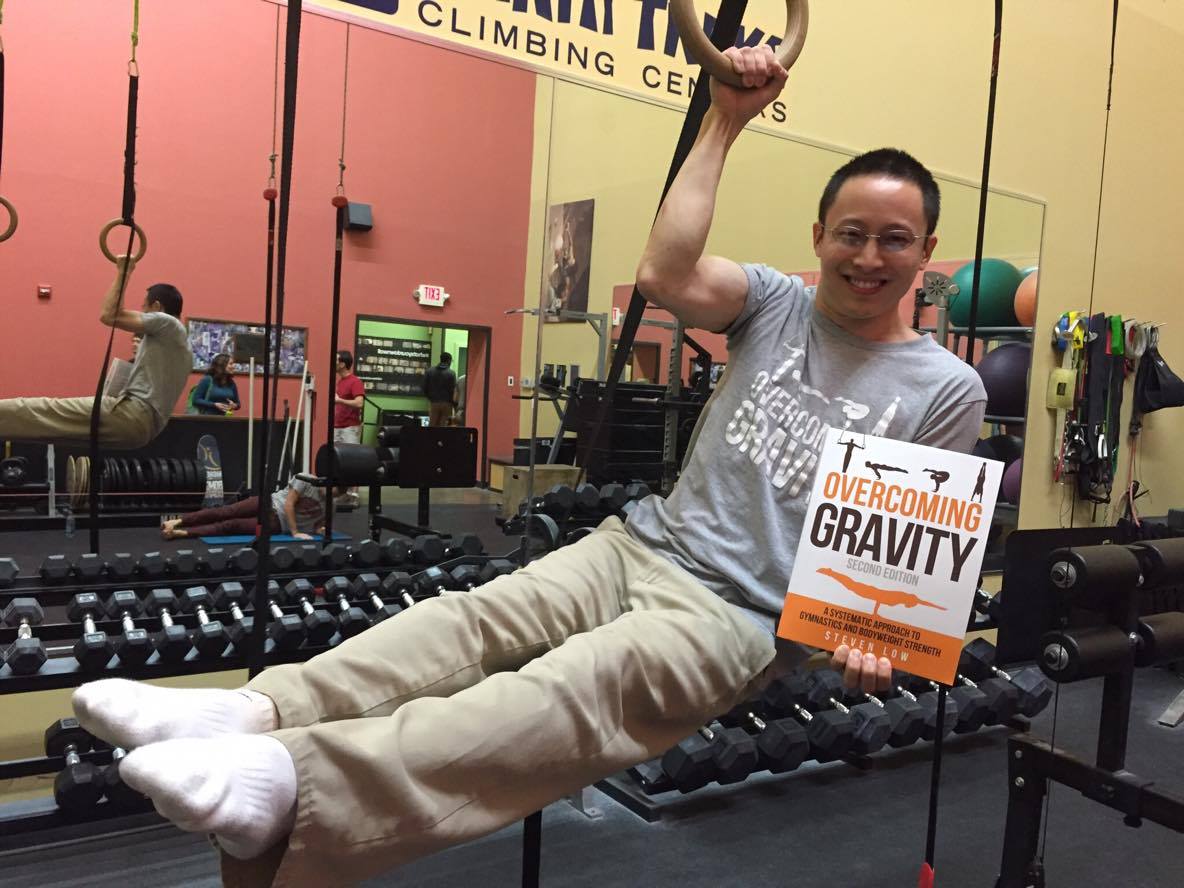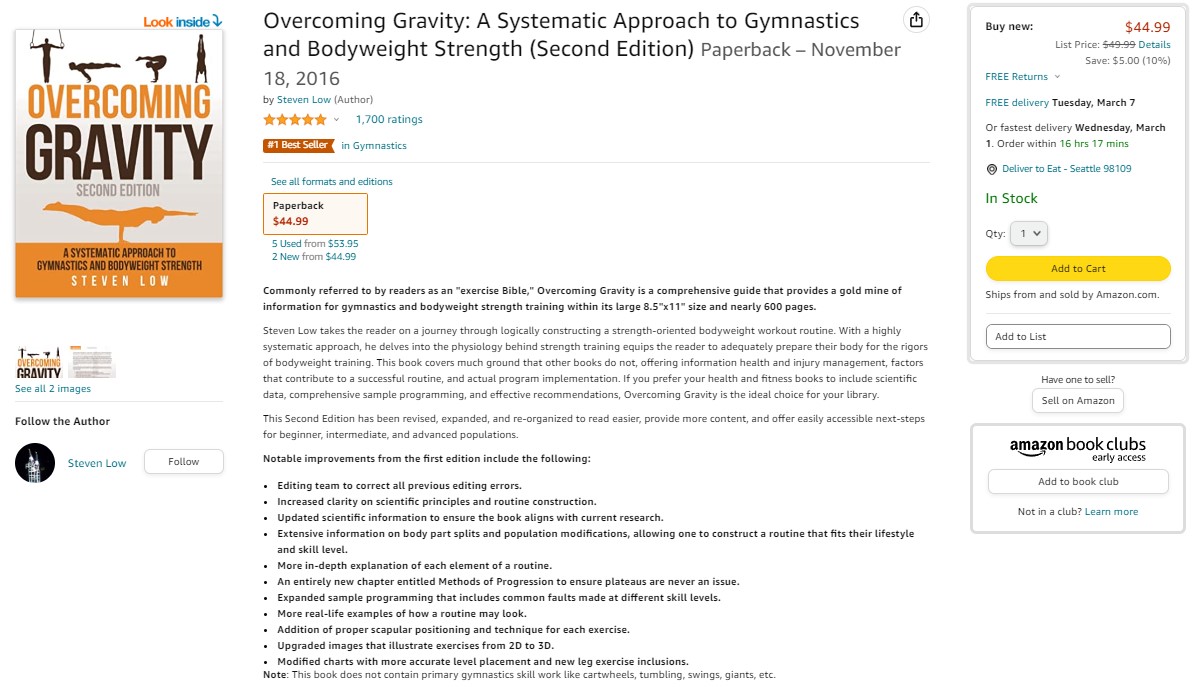
A Beginner’s Guide to Overcoming Gravity: A Systematic Approach to Gymnastics and Bodyweight Strength book or the digital edition in our store.
It has been brought to my attention that some people newer to training may find the level of detail in Overcoming Gravity to be too much to handle at first. Therefore, I’m writing this brief article on how the book should be approached if you are having trouble with the volume of information.
This “article” will also serve as a FAQ for any of you to ask questions about things that you are confused about, and I will try to integrate them into the article as they occur in real time.
Thanks for your patience! I hope you all enjoy the book otherwise.
Table of contents
What you need to know as a newbie
How to construct a workout routine
Types of exercises on the charts
Categorization of horizontal and vertical aspects of pushing and pulling
Skill work
Paralysis by analysis
What you need to know as a newbie
I put the chapter summaries into the book because I am a huge fan of them in lots of other books. Most of the salient points that I wanted you to learn in each chapter are located in each chapter summary.
Therefore, if the level of detail was too high or confusing in some of the chapters, just ignore the chapter itself and focus on the chapter summary.
These are the concepts that I need you to learn to help you effectively construct a routine. The small other details may be useful as you become more familiar with the material.
How to construct a workout routine
The most important points in each chapter to learn how to construct a routine are in the bolded Stop sections at the end of each chapter right before the chapter summary.
Thus, if you want to know “how” construct a routine right away without reading any of the details on the “why”, “when”, etc. then skip to each Stop section in Chapters 3-9 and follow the instructions.
If you need a supplement to the Stop sections, in Appendix C there is a step-by-step guide on page 529 that walks you through how to construct a routine.
The sample programming on page 243 and beyond will also be a good “quick start” to compare your initial programming/routine with how I would make one for each of the levels.
If you are still having issues, check out The Fundamentals of Bodyweight Strength Training which is the article on which the book is based.
Types of exercises on the charts
Each chart contains exercises which are categorized thusly,
- chart #1 – handstand oriented which is a push generally
- chart #2 – front lever, back lever, rows, cross, etc. which are pulling oriented
- chart #3 – planche, dips, pushups which are push oriented
- chart #4 – muscle ups, and other skill types which are combined or vary
Categorization of horizontal and vertical aspects of pushing and pulling
There has been some confusion about how to categorize exercises according to their type. This expounds on the previous question about the type of exercises each chart contains.
Just think about the direction of the force your hands are going – if it’s going up or down it’s vertical. If it’s going horizontal then it’s horizontal.
Therefore,
- Vertical pulling – pullups, inverted pullups, etc.
- Horizontal pulling – Front lever, back lever, rows, etc.
- Vertical pushing – HSPUs, dips, etc
- Horizontal pushing – Pushups, planche, etc
Skill work
There was a good discussion on reddit about skill work. I’ll post some of the clarifications here.
In general, “skill work” in any sport is anything that you need to practice a lot to improve your sports specific skills.
For most gymnastics based skills, this is going to be more along the lines of any type of balance skills that need a lot of practice — handstands, elbow levers, and more in the context of movement type exercises such as swings, tumbling, rolling, flips, etc.
I don’t like saying most of the “strength” isometrics like planche, front lever, back lever are/will be skill work. I said in sample programming section that they can be used as warm up if you drop down the 2-3 levels of ability. However, since once you can do say a straddle planche, you don’t actually have to practice tuck planche much to be good at it then I wouldn’t actually consider it skill work in the strictest sense of the word. You can use decreased levels for warm up, but not skill work. Make sense?
I wrote about this a bit more on page 247:
The key behind all skill work is the fact that the more you practice at something the faster you will
get better at it. However, too much practice with skills even as simple as handstands can impair recovery.
There needs to be balance (no pun intended) to facilitate optimal improvement.How we hit this balance is a tough question to consider. For most people, simply getting upside down
in a handstand is a hard feat. For those more experienced who can hold a freestanding handstand longer
than a minute, 10 minutes of total work would not be a stretch of the imagination.I think the best way to approach skill work is like the warm up. It should not leave you excessively
tired or sweaty to start performing your strength workouts. This may be only 20 seconds inverted for new
people but maybe even 15-20 minutes for more experienced people trying to learn advanced skills like one
arm handstand. You are aiming to get the greatest quality of work without fatiguing yourself such that
your technique is going to deteriorate.I hope that gives you a better idea of the times you are aiming at. It does not have be a set time such
as five minutes upside down six-seven days a week. I would play it more by feel. Aim for quality work
and quit if the skill work is deteriorating or you are having a bad day. There is no shame in knowing that
you cannot do something every day; we all have off days where nothing goes right.
One of the ways that someone told me they were going to implement their handstand skill work is to use the isometric prilepin’s tables that I construct. That is definitely one good way to limit fatigue, especially if you’re new to a skill and you can only do it for a max set amount of time.
However, sets, rest times, etc. pretty much depend on when you feel you are sufficiently recovered to do good quality work. As you get stronger and more conditioned, the rest times between skill work sets will decrease which is why I hesitate saying wait 3-5 minutes like I would say with typical strength work or along those lines.
For example, for say an alloted 15 minutes of “handstand” work before you get to your routine, as a beginner you might only spend about 3 minutes inverted because it’s fatiguing to be upside down that much. But once you get to a higher level you may be holding sets of 30s+ of handstands and be able to work at least 10 of those sets. So you may be inverted 5 minutes of that time total. As you get better, you may be inverted 7+ of those minutes. So it depends.
Paralysis by analysis
If you are having “paralysis by analysis” trying to get everything perfect or trying to fit everything in or are still confused with programming I want you to take a step back and take a few deep breaths.
The aim of Overcoming Gravity or the digital edition in our store is to teach you how to construct an effective and safe routine to work towards your goals.
The book is here to guide you through that process. You will get better as you practice more. However, you can really only learn by doing and making some mistakes.
Construct a routine. It does not matter if it’s perfect or not. As long as it fits your goals and is structurally balanced it will be a good place to start.
If you are still concerned and want some feedback, feel free to post your goals, current abilities, and proposed new routine in the comments section and I will help critique it for you.
But please do not spend weeks trying to figure out something perfect. It’s a waste of valuable training and learning time.
Physical activity is not something we can be perfect in at the beginning when we start unlike book knowledge.
Feel free to ask any other questions or comments about the book.
If you want constructive feedback on your particular routine make sure to include:
- Your goals
- Height & weight
- Current max abilities
- Proposed routine
- Any other specific questions you may have
Thanks for your support, and don’t forget to submit an Amazon review.


Thanks for this. I’ve been slowly chipping away at the book but I have a tendency (as an avid reader) to want to read “in order” so jumping around is a little difficult but I’m going to approach the book not as a story but as an encyclopedia, or a website, where I’m free to read about.
It is quite a lot though, but all we have is time thankfully. Thanks for writing such a detailed book, but yes, it can get a little heavy!
Sounds good.
Feel free to ask any questions if you need help.
hey steven, i just purchased the book, excellent by the way. on the way to a strict bar muscle up, are the clap pull ups and the other explosive vertical pulling exercises good progression exercises to acheive a strict muscle up. should i construct my workouts around these?
@ John Roberts
I would suggest starting with general strengthening exercises. Some type of inverted row and progression to front lever pullups, and any type of vertical pulling progress. Explosive pullups fits there if you want to use it, or you can go the weighted pullups route, or the one arm chin route as well.
thank you. my other goal is a lengthy controlled handstand. at the minute i can kick up and hold a free standing handstand, but only hold it for a maximum of about 3 seconds before i tip over toward my back. will it just come naturally with more practice, or is anything causing me to tip over?
One thing that was not really mentioned much was how to incorporate barbell and Olympic lifts into the programming for lower body focus. Can you please advise on how to incorporate this into programming?
Cheers
I was actually going to write a separate article on this.
It’s been in my queue for a while now — I’ll probably address it after I’m done working on the posture and revamped energy systems article.
If you throw up your goals and a routine proposed I can critique it for you if you want. Generally speaking, whether full body or split it’s fine, but selecting goals is much more important because weight and bodyweight can supplement each other well, but they don’t have as much pure translation to other skills.
Hey man, is this book available as an eBook for the Kindle and/or iPad?
K
Unfortunately, there is only the physical book copy from Amazon at the moment.
We are looking into other options for release though I’m not sure when that will be.
Should be pretty easy to publish for the Kindle at this link https://kdp.amazon.com/self-publishing/signin
Only amazon takes a 30% cut, so you may not want to
Yeah, if we do an online release I’d like it to be a PDF. I need to figure out if I can do that separately or if it has to be through my publisher, and I don’t think my publisher may do anything but kindle. I’ll have to see.
Thanks for the infos.
Steven Hi!
I am looking for a book that can give me all the information I need to create a good program/routine. That explains how I can do to advance. With examples of different routines, to start from.
I have noticed that I am currently unable to exercise for more than three days a week.
I also seek a book on how to, step by step, learn how to do handstand pushups.
Is this the right book for me?
I read your article above and it seems like your book can help me.
Best regards,
Peter
Hey Peter,
The book does not have specific routines because I don’t really believe much in specific routines. However, it does have progressions and it teaches you how to construct a routine towards your goals.
Therefore, it can/will teach to learn to construct a routine towards building up to a handstand pushup if that’s what you’re looking for.
3x a week is also perfect for starting out with gymnastics based strength work.
So yes, I would recommend the book to you. If you have any questions or want help constructing a routine after reading I can help out with that as well.
Hi Steven!
Some help sounds great. I’ll buy the book and come back to you in a couple of weeks.
Best Regards,
Peter
Steven,
I bougt the book from Amazon last night. I will take a up to two months until i get it though. I live in Sweden.
I would love to get some help constructing a routine… can you email me?
Best regards,
Peter
Hit me up at steve [at] eatmoveimprove (dot) com
Make sure you include the details I put at the bottom of this article (goals, height/weight, proposed routine, questions, etc.).
Hi Steven,
I truly enjoyed your book. I do,however, have a few questions for you based on my training level & goals. I am actually a gymnast, and I can perform many of the level 11+ progressions from your book but there are a few that I am not as balanced on due to an uneven training regime throughout my gymnastics career. For example, I am able to do many cross variations but am not proficient in manna work. Here is my problem though, I confused how to incorporate other training elements into a body weight program. For instance, how do I incorporate weight training & bodyweight training so that I can continuously force adaptations? Is there ever a time and place for HIIT training and if so, when? I recently have been doing warmup/skill work-prehab/Str (weights/bodyweight circuits)/GPP using similar str moves in a Tabada like fashion (such as 10min timed 10 free hspu with sled push for as many rounds in the time) and then stretching. I have made incredible strength gains but I want to know that I am on the right track because I do mix weights/bodyweight into my workouts in circuits. Help me Steven!!
Oh yeah, and I forgot to mention that I am stubborn as all get out in terms of my workouts being structured as body part splits… Don’t ask me why.. it is just a carry over from fifteen year old me getting into weight training to suppliment my gymnastics and forming bodybuilding type training habits. I am better about my push/pull but they are still structured in a body part fashion. For example, my vertical pushing is what I consider my “shoulder day” and I add those supplimentary lifts with weights like I mentioned above. Horizontal pushing is my “chest” day and like I said (or wrote I guess) I mix str/gpp circuits into many workouts. I really would appreciate advice because although I have made gains, I want to continue that trend. Is it wrong to split my workout days like that? if so how can I restructure? I also have gymnastics practice three times a week
What exactly is your routine(s) and goals? What are you doing that you think needs to be changed or improved?
I need more specifics because most of your questions are vague to which I could literally write a couple pages on each question depending on specific sets of circumstances.
Generally speaking, I don’t like circuits as much for strength because most of the time they are performed with very little rest and therefore become metabolic before they significant tax strength. However, if they are designed correctly, (such as alternating push/pull/leg exercises with rest between them) that is a decent way to make them a bit more biased towards strength.
I am also a non-believer in most conditioning in general for gymnastics routines as it isn’t really that needed. The longest routine you’ll have is 90s on the floor, and endurance for that is often compiled enough by just being strong and practicing tumbling passes during floor work.
However, if you want something specific you’ll have to post the goals and routines for critique and what you think you want to improve upon and I’ll help you sort through the whys behind programming.
Steven,
Thank you for getting back to me. Honestly, if you were to write a couple pages on each question I would gladly read them and log them into my brain
However, I will be more specific. My specific goal, as of now, is to perform a fledging element into an L sit cross and transition straight into a maltese. Now, with that being stated, my maltese is weak and the work I do is theraband and/or using the straps w/ my feet. I started very basic with working backnd front fledging skills into my skill section of the workout. I also add cross pulls to skill section depending on how I feel. For str I started with straight body/bent arm press handstand for reps of 5-6. I will progress in the next microcycle to straight arm/straight body.I also added cross pull to support to pike press as a mini routine to prepare for the eventual cross press to maltese.
Ok, with that being stated please critique me where you think I need to be. Here is one of my problems, I love doing GPP work but I never overlap it with strength. What I mean by that is I will structure a workout such as: warmup/prehab, skill, bodyweight strength goals and then weighted suppimentary (like db shoulder press), then after str is done I do an auxillary circuit (lateral raise, front raise, etc.) and if it fits I will do GPP such as mentioned above with the hspu timed stuff. I tend, or at least have in the past, allocated my volume to fit my body part split psychcosis. So I do the supplimentary weighted lifts, such as shoulder press, on my “shoulder day.” This is on a 4x week split with my bodyweight training staying within push/pull system and supplimentary being more of a body part split. I know that I could take my overall volume and create full body/push pull weight routines as well but I truly lack the experience doing that. This week I am planning on completely deloading from weights and doing 3x week full body/bodyweight M/W/F workout as my recovery week. Now, back to GPP stuff, even in practice there is a general conditioning (10x muscle ups, hs walk down the floor and back, rope climbs, etc for time or other types of GPP conditioning) so it is pretty ingrained into my brain to add that, if there is time, at the end of a workout. Is this completely unnecessary?
What I really wanted you to do is type out a typically week…. so I know what exactly you are doing and then the questions that you want to ask about it.
But for the sake of not being clear I’ll try myself. From what I gather you are doing:
M – push str + supplementary weights + circuit (focused on body part split) then GPP afterward
Tu – pull str + supplementary weights + circuit (focused on body part split) then GPP afterward
W – ?
Th – push str + supplementary weights + circuit (focused on body part split) then GPP afterward
F – pull str + supplementary weights + circuit (focused on body part split) then GPP afterward
Sa – ?
Su – ?
And then somewhere in the middle or beginning or end of practice your coach implements general conditioning or something like that?
There is some of this that does seem unnecessary, but I need more details.
I don’t see a problem in general with splitting stuff up into push/pull or even potentially body part split at your level of strength. However, if you’re doing like random hodgepodge type stuff and just adding additional volume (plus what the coach prescribes) a bunch of it does seem pretty unnecessary.
Most the “general conditioning” like rope, or some HSPUs, or muscle ups I’d just throw into your warm up to be honest since those are going to be very easy for you. Keep the volume low, and use it to warm up the body for practice. There’s no need to do some random GPP circuit in the middle or end of the practice, especially if you want to focus on strength work.
I will wait until you have further clarified I guess.
ok, first I need to clarify a mistake that I made previously. I wrote maltese when I meant inverted cross. Maltese was originally supposed to be in my routine but it has been nixed for now.
You are essentially right about the schedule. Wed/Sun are rest days and Sat is practice along with weekday practices. It looks like this.
M- two leg push + pull weight movements (RDL’s, SLDL, Squat etc) auxillary with pistol variation+lunge variation etc
T- Push str with supplimentary weights (mostly horizontal pushing with weights) auxilary circuit (chest flys etc. generally three workouts in a circuit) No GPP that day
Th-Pull str with supplimentary weights (both vertical + horizontal pull) and GPP as the auxilary circuit. (example: renegade row+tire flip for prescribed distance+hammer slams with 65s intbetween each)
F- push str with supplimentary weights (all vertical push) + auxillary circuit/triset
S- practice ( I have practice throughout the week too but it is mostly routine work at the moment)
Ok, so that is a general idea of what I have been doing. I count auxilary circuits as GPP a lot of times or do plain GPP for my auxilary). Sometimes on my rest days I’ll end up stretching splits/pancake/pike along with isometric holds like my floor straddle L, but that just depends on how I feel. I guess one of my main questions was about supplimentary work and auxilary. I know that auxilary is more for aeshetics but I like doing them. My auxilary circuits can be off the wall things like db fly w/leg raise+pushup on core ball with feet on another core ball+30 med ball wall expl. push. A lot of times, as I stated, I count it as GPP based on its interval nature but, again, I just want to be on the right track.
So you have 1 legs, 2 push upper, and 1 pull upper day a day? Or is the pull work during leg day also a pull for upper body?
I don’t see a problem with main exercises + supplimentary and/or auxillary work. There’s no real such thing as useless hypertrophy for rings for the most part as long as it doesn’t interfere with your mobility for gymnastics.
However, I don’t think the auxillary work needs to be circuits. Lateral raises, or any isolation work for hypertrophy/strength seems fine enough.
Basically, what it comes down to is that you should be making progress on any routine you are currently on. If you’re not then you need to fix/change something up.
You are to the level of strength where you already have such a high conditioning level that you really don’t need the circuits for your routines, unless maybe you want to use one once a week or something because most of your practice skill work will build base endurance anyway.
Does that make sense?
Yeah, so do I keep auxillary separate per exercise, meaning let’s say its shoulder auxillary 3×8 lateral raises then 3×8 front raises etc. or can I super set or tri set them to save time? And I see what you mean about the circuits but if I did one to “shock” my system once a week or so would that be alright? And the leg days is strictly push/pull excersises for legs… there are times when I add a shoulder push too in a leg movement such as lunge single arm kettle bell press etc.
I have been having great results strength wise and my tumbling has become more powerful. The only thing missing (until I read your book) was the body weight programming integrated into my supplimentary workouts. What I mean is that I would do most of my body weight conditioning in practice and add it randomly to my supplimentary weight training. However, now I put the BW str program right before supplimentary str so that I don’t have to wait until practice to work on my skills in progression. That is the main reason why I was worried about auxillary stuff is because I was afraid that you would look at what I am doing and say it is too much.
This is a side note but I mentioned before that I am deloading from weights with a 3x week pure BW full body routine. I was thinking about doing a light-heavy type by adding an exercise for push/pull to each sucessive workout and also bumping it up a progression each time. So I’d start with relatively easier progressions at maybe level ten and be at the hardest progressions by the last. Does that seem ok? Also you mentioned just throwing muscle ups/hspu into warmup and I like that. Will one set of 10-15 be low enough volume? I also do ring hs holds bail to back uprise Lsit hold in my skill work along with my fledging progressions I am working on but I honestly spend like 30 minutes just in skill and I don’t know if it shouamld be shorter? should I limit the amount of skills performed even (say 3x per skill no matter what) because I tend to keep at one skill until I have performed it up to the level that I feel I should have at least four times, which means when I screw up it takes me longer
I truly appreciate your feedback as it is helping me organize my training and answering some festering questions in my brain so thank you for all that you do for the BW community and your feedback to me.
I tend to call everything else not strength that focuses on aesthetics/hypertrophy supplemental work so it’s confusing me a bit.
So yes, auxillary exercises focused on hypertrophy can be done any way you want. Supersets are fine. Remember, in chapter 2 I talked about hypertrophy and the multiple pathways. Supersetting is basically reinforcing metabolic induced hypertrophy. If you plateau on that you may want to use a different method. But if it’s working for now keep it because it can save time for you.
That make sense?
Yeah, the balance between too much and not enough is fairly difficult to discern at higher levels. The fact of the matter is that generally you should try to eliminate things that aren’t helping you get stronger (such as the random conditioning that you say you do) because it’s not actually going to help you as much as the more strength focused specific work for rings and whatnot.
Generally speaking though, remember that “when you plateau” or if your tendons/joints are feeling sore tend to be good methods of discerning whether something is too much. There’s nothing wrong with adding the isolations, especially if they’re helping you increase muscle mass which is going to make you stronger. But there is something wrong with adding them, if you’re plateauing and not making progress.
That deloading idea sounds great at your level, especially if you haven’t taken one in a while.
One or two sets, from what I’ve found, is good for warm up. This is the time where it’s fine to do things in “circuit” fashion if you do desire and mostly higher reps.
Sport specific skill work in practice depends on how much time your coach wants you there. So I’d talk to him about that type of stuff. The skill training section is mostly written under the assumption of non-gymnasts who are interested in bodyweight exercise. Therefore, your skill sessions in typical 4+ hours of practice may be anywhere from like 1-3 hours depending on how your coach likes to structure it.
All of that make things much more clear?
Let me know if you have anymore questions. Oh yeah, and don’t forget to submit an Amazon review.
Hello.Sorry for the long post. I have a question about the program design. I have already order the book through amazon.com (it’ll take month to arrive) using the mail above if you wish to check. I wish to excel in all horizontal and vertical pulls/push exercises. Should i stick with one same direction pull and push until plateau and then switch to another direction or should i alternate between them each day?
EXAMPLE 1:
Day 1 to DAY XX UNTIL PLATEAU
PULL-UPS
HSPUS
PISTOLS
AB WHEELS
EXAMPLE 2:
DAY 1 & 4
PULLUPS,HSPUS,PISTOLS,CORE
DAY 2 & 5
DIPS,DEADLIFTS,CORE
DAY 3 & 6
PUSHUPS,FRONT/BACK LEVERS,PISTOLS,CORE
For the most part, I like the 2 upper push, 2 upper pull, 1-2 legs (maybe add in a core exercise) template with 3x a week frequency to start.
This will give higher frequency of exercises which should lead to higher strength gains, and it’s more goal directed to a few goals as compared to broad based.
This article, which the book is based around, is the simple version of what I am talking about:
http://www.eatmoveimprove.com/2010/03/the-fundamentals-of-bodyweight-strength-training
Does this answer your question? Or do you need more information? Let me know.
I’ve already been training for 2 years now. I’m 181cm, 75kg. i feel when i’m doing pullups instead of front lever, fl doesn’t improve and vice versa. My current front lever is one leg straight and the other tucked (straight back). I wish to improve both in the lever and in the pullups as well as in deadlift. I just can’t figure how to implement all three pulling exercises into a routine. Same goes with my planche/handstand and one arm pushups. I can go from tucked planche to handstand. Don’t want to lose that skill if i switch to plain one arm pushups and vice versa etc. That’s what i meant in excelling in all three pulling & pushing exercises. Thank you the reply.
Ah, yeah, there is some carry over if you are progressing both in strength. But generally speaking, once you get to high enough levels the transference gets smaller (but it is still there to some degree).
If you have 2 years of training behind you there’s probably no reason why you can’t be doing all of those in a 3x a week routine.
Handstand work
Then for the routine:
Pullups,
Front lever,
planche,
one arm pushups
And finish off with DL.
That would work fine.
Thanks for the reply. I have been trying to do something similar but i have managed to get triceps tendonitis twice in 2 months period though i have made nice improvements. I was using a 60%-70% of an 8-10 RM . According to you, since you have loads more experience than me, I only have me to blame for not conditioning my triceps properly. Thank you very much.
Well, things can sneak up on you, and I don’t really blame anyone for letting things happen or not. If you’re not training hard you won’t reap the benefits of improved ability to do exercises, but it needs to be balanced with not doing too much.
Even when you are experienced with exercise, finding the line can be difficult to do at times.
I would suggest removing anything from your routine that aggravates it, and doing a lot of soft tissue work to the triceps to loosen it up. Ice perhaps, if it helps. And there’s a bunch more things you can do from the tendonitis article on our site depending on the stage of your tendonitis issue.
I hope that helps!
Hi Steven, I bought your book, excellent material, congratulations on true effort. Just quick question. On page where you talk about isometric, concentric, eccentric charts with reps or seconds for progress, what if we work for example handstand holds and already we can hold for 1 minute or any static position if we can hold longer then 40 sec, because in charts the maximum is 33 sec. English is not my natural language, sorry if I missed something in the book. Thank you !
Handstands, which are more skill based because they require balance, are not considered a concentric/isometric/eccentric based exercise.
The Concentric/isometrics/eccentric based charts should be used for exercises where you are working on building your strength (e.g. the power/strength) portion of your routine.
Therefore, handstands and other more balanced based skills such as elbow levers (which are put into the skill work portion of the routine) do not need to use the prilepin charts.
If you’re aiming to work on endurance for your skills then you can definitely hold them much longer than 33s even up to 2+ minutes. That’s absolutely fine. This is the same for people looking to work with L-sits up past a minute too.
For most people with the strength work, it is not necessary to get the isometric strength exercises such as planche, front lever, back lever, etc. up to a minute hold before you can progress to the next progression. That is why the chart only goes up to 33s.
Does that make sense?
Glad you like the book. And don’t forget to throw up an Amazon review.
Thank you for your answer, yes thats make sense, perfect, I start to work on routine that i make based on your book. I will also put mine review on amazon, at the moment you have leadership on bodyweight strength based books.
Awesome. Let me know how it turns out.
My review now is publish on Amazon. Here is the link
http://www.amazon.com/Overcoming-Gravity-Systematic-Gymnastics-Bodyweight/product-reviews/1467933120/ref=cm_cr_dp_synop?ie=UTF8&showViewpoints=0&sortBy=bySubmissionDateDescending#R17JQTV3YEXR3O
I’ve read your articles and am convinced to buy the book. It’s basically what I’ve been searching for, for a long time.
Now a quick question. If I’m looking to replace Back Lever isometrics with full ROM movements, would the back pull on rings be a valid movement?
Thank you for your time. (And for providing such an amazing book)
I should include some info as well. I’m 5′ 11″/181cm 75kg/165lbs. I’ve been doing the gymnastic bodies WOD’s for a while, I’m still at novice level strength (according to this chart https://docs.google.com/spreadsheet/ccc?key=0ArzTY8Rx2z1DdDZlaUVxa1NISlQ0RVpMYVlRaklJelE#gid=0)
My proposed routine: M/T/R/F – A/B/A/B
Every on day:
Warm up
Scapular mobilization and German Hangs
Handstand Work 5-10 min.
L-sit/Straddle-L work
A/B days:
Push:
Advanced Frog (A) / Ring Pseudo Planche Pushups (B)
Negative HeS Pushups (all days)
Negative Ring Dips (all days)
Pull:
Pullups – L sit (all days)
Back Pulls (A) / Back Lever Holds (B)
Front Lever Pulls (A) / Front Lever Holds (B)
My main goals (and my weaknesses) are achieving freestanding handstand pushups, and getting a very strong L-sit (and eventually manna). I’ve always been a fan of the isometrics, these I consider my secondary goals.
I can hold a FL flat tuck (20 seconds) a back lever tuck (25 sec) and advanced frog stand (15 seconds)
Questions:
I tried to cycle the amount of work I do between Push and Pull so I don’t burn out too quickly by alternating days with more static emphasis and days with more movement emphasis. I’m going to be doing this for a few weeks and see how my body responds.
Is my pull day balanced? Front and back lever are considered horizontal pulling correct? Coupled with pullups (vertical) I believe it’s balanced. Or would you recommend a ring row?
Again, thank you for your time.
That would work fine. The back pulls are a good ROM replacement for back lever statics.
Freestanding HSPUs require both a good free standing handstand and the strength to do the handstand pushups. Since you have both in your routine you are on the right track.
This routine looks fine to start. It’s definitely balanced out well, and you have some experience with the movements it looks like which means it may not be too much for you going 4 days a week.
Try it out and see how you do.
If you have anymore questions feel free to ask. And don’t forget to submit an Amazon review.
Thank you very much for the reply, you obviously care about the people you’re helping and with your knowledge you’re probably the best one for the job. I’ll be sure to throw up a review once I get the book. Thanks again.
You’re welcome. Let me know how it goes!
Hey Steve, really nice work on this book
After reading it I had a few comments, possibly for preparing the second edition:
- a glossary or index of technical terms would be very useful to the non-initiate. Although I had a pretty good idea about what it was, I still spent a while looking for your definitions of concentric, eccentric and isometric exercises. There’s a lot of other technical terms and/or abbreviations that you need to talk about before you need to define them precisely (1RM, sets, etc).
- I would also think others might appreciate a list of bibliography, especially as you often refer about some study or some article on certain topics. It’s nice to be able to check on your sources.
- overall, the raw beginner exercises could be more detailed and more basic level progression advice would be helpful. I fear many enthusiasts with limited base skills would quickly become frustrated because level 1 and 2 exercises are challenging (e.g. not enough strength for many girls and not enough flexibility for many guys). Thanks for including the details on stretching, it is most helpful!
- try to convince someone to edit the text for you, grammar and typo problems tend to show up as you advance toward later chapters.
Finally, a small question: assuming one lives a busy life and cannot easily devote 1-2h every other day to training, how would you restructure programming on a basis of possibly daily exercise but limited to 1/2h max.?
If you’re still in the area next time I stop by Primal, I’ll have to request an autograph
Great stuff, thanks!
Thanks Pilou!
I’m making a list of things I need to correct for the next edition, so I’ll add those to my already fairly lengthy list, hah.
I’ll try to stop down by Primal again soon.
As far as condensing exercises down goes, I would suggest a very brief warm up of 5ish minutes, then go with 2-3 sets of paired exercises with about 1.5-2 minutes of rest between each set. That should be a solid 6 exercises over 3 total sets that should take around 20 minutes. Then you can stretch a bit and do some mobility work and you are good to go.
Obviously, if you have extra time during the day you can do more mobility or flexibility work and then add in skill work such as handstands to that time period too.
Steven,
The book is amazing and the information is well beyond what I have tried to ascertain from other sources. Simply terrific book and when a second edition comes out I will buy it the day it becomes available.
I have a few quick questions and, If I may be so bold, a couple of things I would love to see in the next edition.
My question is about the L-sit and straddle-L in regards of being able to do them on the floor. If one cannot do them on the floor, as would be my case, how does one go about being able to develop that strength in the shoulders and core? I do have rings but I would like to perform these exercises on the floor as mentioned in your book.
The only comment that I could make about the book needing anything else is probably another section of active flexibility training exercises. Other than that it has been a great wealth of knowledge and I’ve had a grand time figuring out where I am in relation to the graphs and charts provided.
Thank you Steven,
Jason
Jason,
Sorry for answering late. I had the window open to answer yesterday but I must’ve closed it by accident.
For the L-sit/Straddle-L question:
If you’re having issues with depressing the scapulas to hold yourself off the floor I would focus on using the rings support positions to work toward that. Make sure you are pushing the rings down toward your feet the entire time you are above the rings.
Likewise, on the floor you can do the same thing.
I don’t know if are limited by strength (hip flexors and abs) or flexibility (tight hamstrings) or both which may limit you from getting your legs off of the ground in either position. As you may know from reading the book, I like the compression work coupled with stretching for this.
After that, just practicing the movements on the floor will help you build up to it after you develop those 3 requisite components — the shoulder depression strength, the strength in the key muscles, and the flexibility.
Also, thanks for the feedback. We are looking to hopefully add a bit more to the book for the next edition as well.
Let me know if you have anymore questions, and don’t forget to submit an Amazon review!
Steven,
I’ve been enjoying your book for about two weeks now, thank you.
I see the Progression Charts as a key to understanding what you’ve presented here, and I’d like electronic copies of them. If you’ve already posted copies, may I have the link? If not, would you be willing to give me copies?
I know that you gave extra paper copies in Appendix C, but I’d rather not tear pages from the book – and I’d like to add my own personal notes, maybe dates and other comments to keep like a PR diary. Of course I could type all of this in Excel (I nearly did today) but I realize that you’ve already done that.
Thanks for any help you can give me,
Mike
Yep, this thread has the charts. I posted them, but one of the poster’s wife made a nice excel copy that is color coded and everything so you’ll probably want to use that one.
http://eatmoveimprove.com/forum/viewtopic.php?f=18&t=69
https://docs.google.com/spreadsheet/ccc?key=0ArzTY8Rx2z1DdDZlaUVxa1NISlQ0RVpMYVlRaklJelE
Let me know if you have anymore questions. And don’t forget to submit an Amazon review.
Hi Steve,
wonder if you could have a look/have any suggestions for getting my ‘current’ workout in the most efficient order. I’ve a copy of OG (Overcoming Gravity), but seem to be suffering from information overload at the moment! (just read/started with BtGB as a baseline guide around a six weeks ago)
•Your goals
Get more ‘functional’ – I’m sick of just grinding out reps
•Height & weight
age 42, 5′8″ @ 174 (~23%BF – or so the Tanita tells me. Visually I’d say around 19!)
•Current max abilities
HS2wall 30secs, similar with L-sit. Frog planche 15 secs, really hurts inside thighs!?
•Proposed routine
Warmup – 3 to 5 rounds of ‘Neural Charge’,
5 reps of plyo pushup/standing long jump/medball slam/vertical jump
Ring work
4×15secs vert hold on rings, L-sit on rings & invert hold on rings
4×4 pushup/inv row/rear flye/flye/biceps curl/tri extn/dips/front lever – curl up with slow ecc.
Handstand conditioning
3×3 wall walk-ups to handstand
Weights – Squats (PTec Lever machine) 1×20, maybe throw in some KB swings (20@1pood)
Wall handstands 15/20sec sets to total of around 1.5 mins.
Occasionally followed with some Clubbell work to loose/flush the shoulders
Jumprope 3×30secs ‘easy’
•Any other specific questions you may have
The above was/is setup along the BtGB ‘vague’ template. Initially I started with 5x (4×15secs)on the wall HS & totally fried my upper rhomboids for a fortnight!
Thanks in advance,
Pat.
More specific goals would be good.
As it is, the template of
Pushups, inverted rows, dips, front lever + squats and KB swings looks pretty good. I’d keep that.
Add int he handstand work, and the support/inverted holds on rings, and L-sit and you have a decent general routine.
But I don’t know if you just wanted a general routine.
As I said in the above article, if you’re suffering from information overload just stick to the chapter summaries.
If you want to use the “routine building” guidelines check the STOP sections starting at the end of each chapter from about chapter 3 onward. They will give you an idea if what you want to do according to your specific goals.
Let me know if you have anymore questions or want things clarified.
Thanks Steve for the prompt reply!
I must apologise for the less than SMART goals. I should have stated I’m trying to get down to between 12 & 14 %BF which I appreciate is more (90%) nutritional!
Yes – I am after an allround ‘general’ routine. BtGB seemed to put HS ’skill’ work towards the end of a routine, or at least that is my interpretation. Infact after posting the question I decided to put the HS holds at the front end with the ring (skill) work: this worked a treat and the HS work felt better.
I must have had too much time to spare – ‘cos I added in an inverted vertical hold (4×15s) for fun.
Any ideas on the how to eleviate the frog-planche thigh pain/is this normal?
Yep, skill work tends to be best in front of the routine.
Where is your particular pain at? Generally speaking, if it’s pain from your legs being on your elbows that’s fairly normal just like with the elbow levers and the elbow(s) digging into your side. It will eventually start to go away as you get used to it.
If it’s a different type of pain like some type of strain or previous injury or somewhere else then I’m not sure what to tell you because that’s not normal. May be a good idea to get it checked out by a physical therapist or other health professional if that’s the case. If it’s up near the pelvis area that may indicator some form of imbalance or pelvic instability.
Let me know if you have anymore Q’s.
Tried FP again after Boxing last night – OK no probs. I’ve come to the conclusion that the old bodybuilding more-is-better mindset, when starting gym, was responsible for my initial aches & pains!
Thank you Steve – time for me to get reading & dig through the site!
Pat.
Great book Steven. Plenty of exercises to select from. I would like to watch someone else perform some of the exercises to make sure I am doing them correctly. Is there soemwhere on YouTube or another website where I can atch someone with good form perform some of the exercises?
Currently there is not.
However, if you would like an exercise technique critique, post up a video and let me know.
Will the book be available at amazon.CA soon or at all?
I could order it from amazon.com, just checking to make sure.
I sent them an e-mail. This is what they said:
“Thank you for contacting us regarding distribution to Amazon.ca.
Currently we do not offer distribution to Amazon.jp, Amazon.ca or Amazon.cn. We will continue to look into new opportunities to grow our international offerings so you can expand your reach to more customers worldwide.”
Pretty much a non-answer unfortunately. Amazon.com would be your best bet unless you like waiting for an indefinite amount of time.
I’ve paid the extra 10$ for shipping to have it by June 26th. I have patience but not indefinitely!
Let me know if you have questions or want a routine critique after reading through and constructing a routine.
Thanks for the offer. I have a personal trainer (Bachelor’s degree in Kinesiology ) who will look at it with me. He’s interested in getting his own copy, actually.
He advised me to not to try master everything at once ( gymnastics/parkour, weight training, plyometrics, Muay Thai, all sort of training programs ). That also I should focus, setting a goal, and not to over trained.
I’ve identified that I need upper body strength, and I think Overcoming Gravity will suit me very well (with combined Specificity body wieght program). Prior to that, I did lots of muscular endurance weight training.
Good idea. I would generally agree with narrowing the goals down and prioritize.
Is there a list of which exercises would fit in which category.
(page 32 of the book)
1 vertical push upward
1 vertical push downward
1 horizontal push
1 vertical pull downward
1 horizontal pull
This may help:
http://eatmoveimprove.com/forum/viewtopic.php?f=18&t=156
I described the groupings I used to make the different pages of the charts.
Hi Steven
I’m Federico, 21 years old from Italy
and I’m very happy for purchasing Overcoming Gravity 
Now, after a long reading I’ve a question for you.
I’ve choosen my goals and I want to follow your advices about the progression in the skill work with HS and L-sit/V-sit/Manna.
For you, which are the other exercises that could be set as “Skill work”? (I know that is skill work/warmup each 2-3 levels exercises below our “strenght threshold”)
However, the other goals I’ve choosen are:
-the rings dips & RTO pushup (push work)
-pullover (pullup progression) & One arm rows (pull exercise)
-for the legs I love the deadlift (my past WO were weightlifting based)
I hope that I’ve explain all clearly.
Therefore, do you think that with this approach I will lose my goals? I know that I’ve keep long time progressions, do you suggest me being more specific?
I’ve another question, for HS and L-sit I must use the Prilepin’s chart for isometric (for the times)? While for dips, pushup, pullup and rows (unless I use eccentric repetition) I must use the chart for concentric (dynamic movement)?
Thanks a lot Steven
I want congratulate for your book, too
Generally speaking, skill work as listed in the above article are any type of exercise or position that requires you to practice it a lot typically because it has a balance component to get better at. For instance, elbow levers. If there are no things other than like handstand or L/V/M progressions you want to work on that’s fine.
Your workout looks pretty solid, but I am unable to answer your question because you actually didn’t list your exercise goals.
You can use prilepin’s chart for any type of isometric exercise to maximize the amount of quality time in that position. For handstand, though, you don’t necessarily have to use it especially if you are working up to longer holds, but you don’t want to be working to failure during most sets either because that’s when form starts to degrade. So like with exercises you tend to want to stay a bit short of failure and maybe only have the last set work to failure.
And yes, the other exercises can use the concentrics charts. Please note I actually didn’t clarify the concentrics chart too well — it’s made for 2 total exercise. So in general you will want to aim for about 3-6ish reps for strength, 5-8 for hypertrophy and strength, and 5-12 for hypertrophy.
Let me know if you have anymore questions, and don’t forget to submit an Amazon review.
Very very very kind Steven
Thanks a lot! I understand the “issue” about the skill work
However, I don’t know much about my condition in BW exercises, but this evening I’ll test my ability. The goals that I’ve listed before were (are) ideal goals that I think I cannot be able to do now
Though if I’ve some issues I will write here
I’ll submit my review soon
Thanks again
Testing your abilities is definitely one of the first things you should do as that will give you information about what progressions and holds you should be using in your routine.
Sounds good though. Let me know if you have anymore questions.
Hi,
Does the book habe been released in pdf format? If not, do you have an idea when it will be done?
Thanks
Hi Daniel,
There is no release of the PDF of the book yet. Currently my publisher isn’t able to do that though.
I will definitely make a big annoucement if that happens.
Steven:
I’d really like to get a copy of your book having read your website now and the reviews on Amazon.com – however, being up here in Canada, it doesn’t seem to be available on amazon.ca. Any chance you can talk to your publisher about pushing the .ca website to carry your book?
Thanks
Hey Marko,
I actually sent my publisher an e-mail a month or so ago and here was their reply:
“Thank you for contacting us regarding distribution to Amazon.ca.
Currently we do not offer distribution to Amazon.jp, Amazon.ca or Amazon.cn. We will continue to look into new opportunities to grow our international offerings so you can expand your reach to more customers worldwide.”
Pretty much a non-answer unfortunately. You can buy it off Amazon.com although shipping would be a bit higher; that would be your best bet unless you like waiting for an indefinite amount of time.
Steve
Hi Steven, I came across a serious copyright issue regarding your book,
and rather than print the website address here, please email me and I’ll send you the link. I think you should contact that site immediately to shut the page down. Kind regards and thanks so much for all the free information you give on this eatmoveimprove.com site.
Hi Steven.
Ive pretty much finished reading the book through once, i’ll be re-reading it. I’m starting one of your programs today as I’ve just come to the end of my de-load on my previous program. I’m happy to use one of your example programs as it’s not totally different to what i was already doing, which was working, but your program offers much better structure and more volume, which I’d like to follow.
So basically i’m going to try (i don’t have the book with me now, just some notes) the level 3-4 dynamic program. My query is really to do with time and super setting, if that’s the right term to use. My apologies in advance as you’re probably covered this already.
I want to keep my total workouts under an hour. For example with my previous program i would work along the lines of combining quads with push, hams with pull. So something like x reps pull ups (then start my timer), wait a minute of so after finishing the pull ups, the do x reps of pistols on each leg, then once i’d hit 3 minutes (since finishing the 1st set of pull ups) I’d start the next set of pull ups again and so on. I’d have very little rest between sets and I’d do 4 sets of this. I’d then do the same with a push exercise combined with hamstring exercise. However I generally combined legs with upper body as I was doing a lot less upper body work then your program. I’d then follow with a core cicuit along the lines of Lsits, Knees Ab wheel rollouts.
So in the book the example program you’ve outlined for level 3-4 (I’m not including the warm up/skill work/stretching etc in the example) is:
3x (3-8) muscle up assistance work
3x (5-8) of wall HeSPUs
3x (5-10) of Dips / L-Dips
3 x (5-10) of Pull Ups/ L Pull Ups
3 x (5-10) of RTO Push Ups
3 x (5-15) of Rows
+Leg work (which my idea is)
3x (10-20) Pistols
3x 5-10) NLCs
I’ll obviously be adjusting the exercises where my ability is less or more.
So how would you best pair/super set your program so that I can do 2 exercises within about 3.5 to 4 minutes so the muscles I’m using aren’t fatigued too much, taking into consideration my leg work? Or is the order of exercises already paired as such ?
Also what are your ideas on working pistols, or legs in general? What would you say is the best range to work in to gain strength and some hyper trophy? I ask as various sources advise that higher reps are better due to the amount of work our legs already do so they require extra stimulation.
Many thanks
Greg
Hey Greg,
If you want to get most out of your upper body I’d pair up the legs work with the upper body work, and then when you run out you pair upper push with pull.
So it may be something like Pistols/HeSPUs, Pullups/leg curls, and then Dips/rows, pushups/muscles ups. In any order you want to group things though…. typically exercises that come earlier are better.
3 upper push/pull is a lot though if you’re just starting out (L1-4) so I would consider dropping 1 push and 1 pull potentially. But it’s up to you.
Legs if you want hypertrophy and strength you should absolutely be using barbells over bodyweight leg exercises.
Cheers Steven.
I’ve reduced the amount of excercises as suggested so i’ll see how it goes. I’ve been looking at the OG reddit page and i’m re-reading the book so once i’ve done that i’ll probably come back with more questions.
Amazing customer service BTW! I left a review on amazon.co.uk bigging up the book.
Thanks. Let me know how it goes. (I check reddit more than article comments so if you want a quicker reply I’d go there).
i will order the book from amazon but i ‘ d like ask something. I suffer from some brachial plexus issue (thoracic outlet syndrome) and or some mild form of carpal tunnel. Thje cause of my injuries is probably the heavy power lifting that i did. Now, my doctor suggest me to avoid any weight lifitng exercise & any overhead movements, but to train with bodyweight exercises. Do you think that i could create a routine with bodyweight exercise without problem? could you please help me to this purpose when i will have your book?
This is actually a complex issue and I don’t have a good answer for it.
TOS and carpal tunnel can be related to postural or biomechanics issues, or other previous injuries, or other factors so I’m not sure what is causing those issues in the first place. It would be good if you could provide enough information online for me to make a guess, but sadly it’s impossible to really assess yourself on these.
Have you talked to a physical therapist about your current situation?
Going overhead shouldn’t be an issue because it’s just for sets, and it won’t necessarily aggravate TOS depending on what is causing the issue…. however it could on the other hand. So I really don’t have enough info on it.
Steven, thank you for your responce. Actually, i am on physical therapy right now, with ice, ultrasounds & also chripractic treatment, wich hepl me a lot. My chiropractic therapist & the Physiatrist told me that the prblem that i have is because of my bad posture (round shoulders, forward neck) & of the heavy deadlifts that i did. I test a lot of exercises to see what aggrevate the symptoms (tingling in the hands). Swings, back squats aggrevate them. Push ups, shrugs, orizontal pull ups, l-sit position are ok.
Yep, just keep it simple for now and then add on more as you start to improve.
I would suggest working the posture from the tilted sternum method (aka puffed up chest like you just saw a pretty girl on the beach). This automatically rotates the shoulders and head back into a better alignment making it easier.
hello Steven! today i recieved your book!excellent work! Please, take a look at my program. I have 2 goals, the front lever pull ups & the planche push ups. For now ( considering my neck injury-cervical syndrome of the A6-A7 discs) i will training 2-3 times weekly, i will do rows (page 369) until i will be able to perform 3 tuck front lever pull ups & regular push ups (page 439) until i will be able to perform 3 tuck frog push ups(page 432). For the legs some deck squats. What do you think?any suggestion for core work or anything alse please?
thanks!
i just order your book, i am exciting to read it & put it in practice. I will inform you when it will arrive!
hi I wanted to know how do you do to make a training that will help you get strong but also powerful. What I mean by powerful is being able to do movements with a good pace and not only slowly.
The recommendations in Overcoming Gravity are for those who want to do strength and power movements.
hello Steven! today i recieved your book!excellent work! Please, take a look at my program. I have 2 goals, the front lever pull ups & the planche push ups. For now ( considering my neck injury-cervical syndrome of the A6-A7 discs) i will training 2-3 times weekly, i will do rows (page 369) until i will be able to perform 3 tuck front lever pull ups & regular push ups (page 439) until i will be able to perform 3 tuck frog push ups(page 432). For the legs some deck squats. What do you think?any suggestion for core work or anything alse please?
thanks!
Steven,
I just got the book and am a bit overwhelmed by the breadth and depth of information. I am 6″1′ 180lbs. 29 years old. My proposed routine is a warm up similar to what’s in appendix a. My routine after warm up was about 5-7 min of handstand work. I then moved onto the L-sit progressions. I then did inverted pull ups followed by dips. Then some pike push ups and some chin ups. I then worked on legs. Stretched and cooled down.
My L-sits are at best a level 1. I can hold the wall handstand for one min or so. I consistently do a free handstand for about 3s. Fully inverted pull ups were fun and challenging. I can do a set of 6 or so. Dips were a level 3 with no real difficulty. Then some pike headstand pushups. I believe I could step up to using a box. The chin ups were basic but explosive to about mid torso. I’m not sure that I am balancing the exercises correctly. Thx for the excellent book. Any advice would be appreciated.
Sincerely,
Adam.
That sounds pretty good to start! I typically like rowing/inverted row into front lever pullup progression better than inverted pullups.
Good luck.
Steven,
I love your blog, and recently bought your book. It’s shocking how much knowledge you’ve amassed on the body and exercise.
My background is a combination of standard weightlifting and ‘functional training’. My goal is general strength and cardio, and I’m active in brazilian jui-jitsu.
Couple of questions:
1) For the past month since buying your book I’ve laid off my typical upper-body exercises and have focused on the planche and handstands. I’m holding the frog stand for about 10 seconds now and I’ve started to work my way to holding a solid handstand for 5 seconds. However, I just started getting some tendonitis (ME), which has forced me to stop for a bit. Admittedly, I wasn’t stretching my wrists before the handstands… Do you think this is a probable cause of the tendonitis? Are planches known for this?
2) I was reading the programming section of your book tonight and was a little surprised to see that you suggest doing movement based exercises over isometrics. However, much of your book seems to focus on isometric movements. I’d love to see an article on how to translate train some of these holds (planches, back levers, etc. etc.) with a more movement based approach. You mentioned planche pushup progressions. Are there some others you can suggest?
Thanks,
Matt
1. Typically, medial epicondylitis is from pulling exercises like pullups/chinups/rows… but you are using the wrists a fair amount in the handstand so I can conceivable see that it can irritate the elbows a bit. Planches will not aggravate it unless you’re really leaning forward and putting a lot of stress on your fingertips. What I would suggest is turning your hands sideway so as to take the pressure off of the elbows for now. See the tendonitis information in the book or on this website.
2. If you check out the charts in the exercise section (or at the end of Chapter 5) you’ll see that there’s almost always a paired pullup or pushup progression with the various static exercises.
And yes, I do prefer movement based exercises because they are better at building overall strength than isometrics. Isometrics tend to confer strength to about one position, while movements work a much larger range of motion.
I think I answered you on the reddit thread… I rarely check here so check there.
yes indeed!thank you!
what do you think about my routine?I am mixing bodyweight and barbell.
My goals are to achieve planche,front lever,back lever,OAC,HSPU and improve in 3 main lifts:Deadlift,squat and bench press.
My trainig program looks like this.
MON:warm up,handstand practice for 10 min.,
OAC-eccentrics pair with HSPU eccentrics for 5 sets.
one leg extended fl hold pair with tucked planche hold 5 sets.
Back lever hold 5 sets.
Deadlifts(wendler 531)
Some abs and lower back work.
Flexibility and prehabilitation.
TUE:warm up and handstand practice for 10 min.
PL and FL pair for 5 sets.
BL eccentrics pair with weighted dips for 5 sets.
muscle ups.
flexibility and prehabilitation.
TH:warm up and handstand practice for 10 min.
PL holds and FL eccentrics pair 5 sets.
BL holds and squat(wendler) pair,BL 5 sets and squat 3 sets.
Weighted pull ups and HSPU pair for 5 sets.
Abs and lower back work.
flexibility and prehabilitation.
FRI:warm up and handstand practice for 10 min.
PL and FL pair hold for 5 sets.
BL eccentrics pair with bench press(wendler).
Muscle ups on rings.
Flexibility and prehabilitation.
Focus on improving the wall handstand, learning how to kick up to handstand properly, and balance the handstand with your wrists. Use the cambered hand position as well.